Voice OTP & A2P SMS Routes Available

Best Practices for A2P SMS Delivery and Routing


A2P SMS (Application-to-Person messaging) is a critical communication channel for businesses sending OTPs, alerts, promotions, and notifications. However, ensuring high delivery rates depends heavily on choosing the right A2P SMS messaging strategy and routing setup.
Poor routing, filtering, and network issues can lead to:
- Message delays
- Delivery failures
- Customer dissatisfaction
To build a reliable system, businesses must understand both how A2P SMS works and the best practices behind efficient routing.
What is A2P SMS Routing?
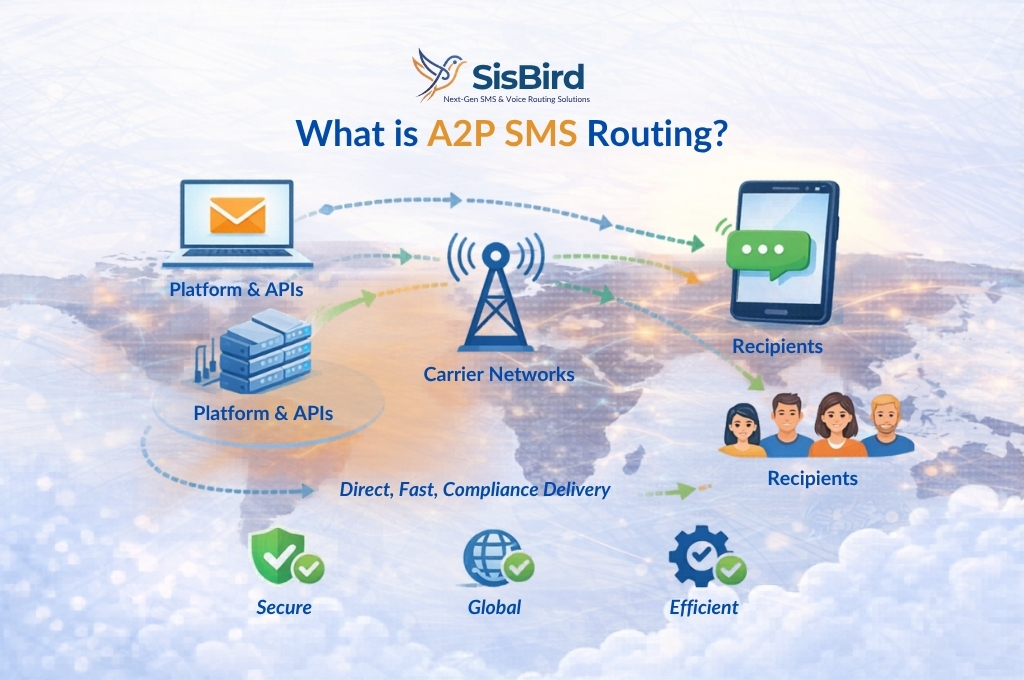
A2P SMS routing refers to the process of sending messages from applications to mobile users through telecom networks using direct carrier connections or aggregators.
If you're new to this concept, you can explore our detailed guide on what is A2P SMS and how it works to understand the fundamentals.
Efficient routing ensures:
- Fast delivery
- High success rates
- Compliance with operator regulations
It also relies on strong telecom routing infrastructure, which plays a key role in global message delivery.
Purus lobortis senectus faucibus imperdiet rutrum porttitor tincidunt laoreet parturient consectetur tortor ad adipiscing id a duis hendrerit diam. A at nec rutrum nam molestie suspendisse scelerisque platea a ut commodo volutpat ullamcorper penatibus dis quis felis justo porta montes nam a vestibulum tristique parturient parturient eget tincidunt. Semper dui.
Best Practices for A2P SMS Delivery and Routing
1. Use Direct Carrier Connections
Avoid unreliable grey routes.
Choose providers with:
- Direct operator partnerships
- Tier-1 routes
- Transparent routing
These are part of a strong global telecom routing infrastructure, ensuring better performance.
Benefits:
- Higher delivery rates
- Lower latency
- Better compliance
2. Optimize Message Routing (LCR vs Quality Routing)
Least Cost Routing (LCR) can reduce costs but may affect quality.
Best approach:
- Use quality routing for OTPs and alerts
- Use LCR for non-critical traffic
Balancing cost and quality is essential for scalable SMS delivery systems.
3. Follow Compliance & Local Regulations
Each country has strict messaging rules.
Ensure:
- Sender ID registration
- Template approvals
- User consent (opt-in/opt-out)
Ignoring compliance can result in blocked messages or penalties.
4. Avoid Spam Triggers in Content
Operators use filters to block spam messages.
Avoid:
- ALL CAPS
- Excessive links
- Spam words (“FREE”, “WIN NOW”)
Use:
- Natural language
- Personalization
- Clear brand identity
5. Monitor Delivery Reports (DLR)
Tracking performance is critical.
Monitor:
- Delivery success rates
- Failures
- Latency
This helps optimize your A2P SMS delivery performance over time.
6. Use Multi-Route Strategy
Never rely on a single route.
Use:
- Primary route
- Backup route
- Failover system
This ensures reliability across global messaging networks.
7. Optimize for Global Delivery
Different regions behave differently.
Best practices:
- Use region-specific routing
- Work with global providers
- Test routes regularly
Strong telecom routing systems make a big difference here.
8. Implement Voice OTP as Backup
For critical messages like authentication:
Strategy:
- Send SMS OTP
- If failed → trigger voice call
Many businesses now combine SMS with voice-based authentication. You can read our detailed SMS OTP vs Voice OTP comparison to understand why this works better.
Also, enterprises are increasingly adopting this method-learn why businesses are switching to Voice OTP for authentication.
9. Use Reliable SMS APIs
Choose APIs that offer:
- High uptime
- Fast integration
- Real-time tracking
This ensures smooth communication between your platform and telecom networks.
10. Scale with Load Balancing
For high-volume messaging:
Use:
- Traffic distribution
- Load balancing
- Smart retry logic
This prevents congestion and improves delivery speed.
Common Mistakes to Avoid
- Using cheap grey routes
- Ignoring compliance rules
- Not monitoring delivery performance
- Sending bulk messages without segmentation
- Relying on a single provider
How SisBird Ensures Reliable A2P SMS Delivery
At SisBird, we provide:
- High-quality A2P SMS routes
- Global carrier connectivity
- Low latency routing
- Secure and compliant messaging
Our infrastructure is built on strong voice and SMS routing systems, ensuring consistent performance.
If you're looking for a reliable A2P SMS provider, SisBird offers scalable and high-performance messaging solutions.
Looking for bulk SMS routing solutions with high delivery rates?

Next-Gen
Routing Solutions
Looking for stable SMS or voice routes? We are ready to help.
Start Your Routing Partnership
FAQ...
1. What is A2P SMS delivery?
A2P SMS delivery is the process of sending messages from applications to users via telecom networks.
2. How can I improve SMS delivery rates?
Use direct routes, avoid spam content, follow regulations, and monitor delivery reports.
3. What is the difference between grey routes and direct routes?
Grey routes are unofficial and unreliable, while direct routes are secure and operator-approved.
4. Why do SMS messages fail?
Common reasons include filtering, routing issues, network problems, and regulatory restrictions.
5. Can Voice OTP improve SMS delivery?
Yes, it acts as a fallback method, ensuring delivery when SMS fails.
🏁 Conclusion
Reliable A2P SMS delivery and routing are essential for modern business communication. By applying best practices like direct routing, compliance, multi-route strategies, and performance monitoring, businesses can significantly improve their messaging success.
For critical communication, combining SMS with voice-based authentication ensures both security and reliability.