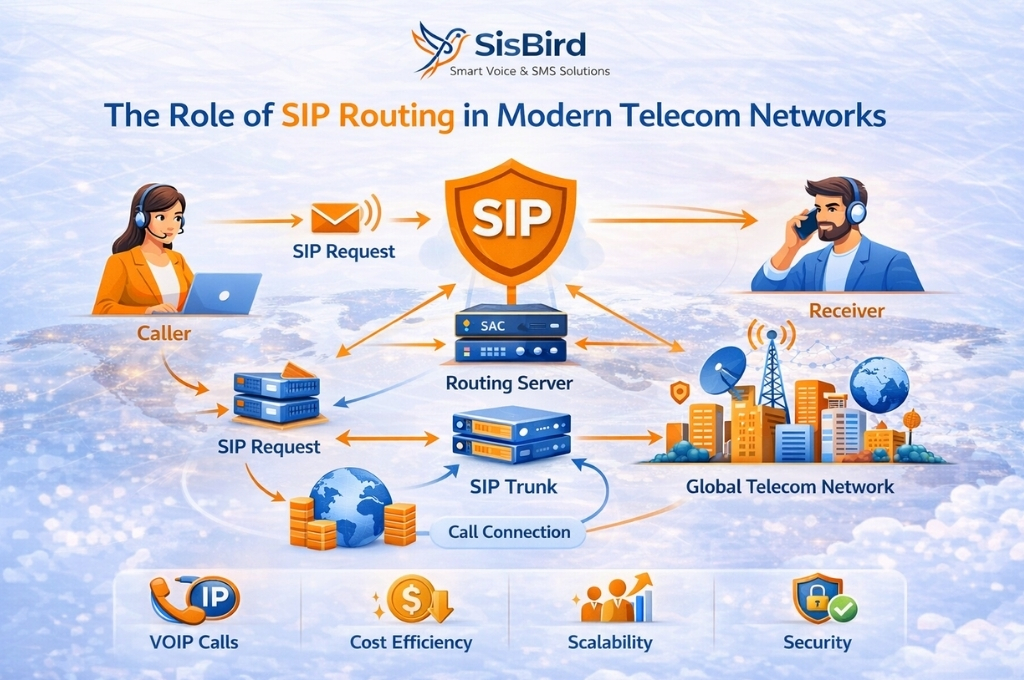
How VOIP Routing Works Behind the Scenes


Every time you make a call over the internet, a complex system works silently in the background to connect you instantly. This system is known as Voice over Internet Protocol routing.
For businesses relying on global communication-like call centers, OTP delivery, and voice broadcasting-understanding how VOIP routing works can help improve call quality, cost efficiency, and reliability.
This entire process depends on strong telecom routing infrastructure, which ensures calls are delivered quickly and efficiently across global networks.
What is VOIP (Voice over Internet Protocol) Routing?
The process of directing voice calls over the internet from the caller to the receiver using telecom networks and routing systems.
Instead of traditional phone lines, VOIP uses:
- Internet connections
- SIP (Session Initiation Protocol)
- Softswitches and routing servers
If you're new, explore our complete guide on Voice over Internet Protocol routing systems and infrastructure to understand the fundamentals.
This allows businesses to make fast, scalable, and cost-effective global calls.
Key Components of VOIP Routing
1. SIP Protocol
SIP (Session Initiation Protocol) is the backbone of VOIP.
It handles:
- Call setup
- Call management
- Call termination
2. Softswitch (Routing Engine)
The softswitch acts as the brain of the system. It:
- Decides the best route for a call
- Manages call traffic
- Applies routing rules
This is where intelligent decisions like least cost routing (LCR) happen.
3. Carriers & Gateways
VOIP providers connect with:
- Tier-1 carriers
- Local telecom operators
- International gateways
These connections are part of a powerful global telecom routing infrastructure, ensuring high-quality communication.
4. Routing Tables
Routing tables store:
- Destination prefixes
- Available routes
- Pricing and quality metrics
The system uses this data to choose the best path for each call.
How VOIP Routing Works (Step-by-Step)

Step 1: Call Initiation
A user places a call via an app, softphone, or telecom system.
Step 2: SIP Request Sent
The system sends a SIP request to the VOIP server.
Step 3: Route Selection
The softswitch analyzes:
- Cost
- Quality
- Availability
Then selects the best route.
Step 4: Call Transmission
The call is routed through carriers and gateways to the destination network.
Step 5: Call Completion
The receiver gets the call, and communication begins.

Types of Voice over Internet Protocol Routing
1. Least Cost Routing (LCR)
- Chooses the cheapest route
- Useful for bulk calls
- May impact quality
2. Quality-Based Routing
- Prioritizes call quality
- Uses premium routes
- Ideal for OTP and business calls
3. Failover Routing
- Switches routes if one fails
- Ensures high reliability
Challenges in VOIP Routing
- Call drops
- Latency issues
- Poor route quality
- Fraud (e.g., call spoofing)
These issues can be minimized with proper routing strategies and monitoring.
VOIP (Voice over Internet Protocol) Routing & Security
Security is critical in VOIP systems.
Best practices include:
- Call encryption (SIP TLS, SRTP)
- Fraud detection systems
- Secure routing policies
Businesses using voice-based authentication systems must ensure secure routing to prevent risks.
VOIP (Voice over Internet Protocol) Routing in Business Use Cases
Voice over Internet Protocol routing powers:
It also works alongside A2P SMS delivery systems for multi-channel communication.
If you're working with messaging, check our guide on best practices for A2P SMS delivery and routing.
How SisBird Powers Voice over Internet Protocol Routing
At SisBird, we provide:
- Global VOIP routing solutions
- Low latency, high-quality routes
- Smart routing with failover
- Secure voice infrastructure
Our platform ensures:
→ High call success rates
→ Cost-efficient routing
→ Reliable global communication
Looking for a reliable VOIP routes provider?
SisBird delivers scalable and enterprise-grade solutions.

Next-Gen
Routing Solutions
Start Your Routing Partnership
FAQ...
1. What is VOIP (Voice over Internet Protocol) routing?
VOIP routing is the process of directing voice calls over the internet using SIP protocols and telecom networks.
2. How does VOIP (Voice over Internet Protocol) routing
routing work?
It routes calls through servers, carriers, and gateways using intelligent routing systems.
3. What is least cost routing?
LCR selects the cheapest route for calls but may compromise quality.
4. Is VOIP (Voice over Internet Protocol) routing
routing secure?
Yes, with encryption and proper security measures, VOIP routing can be highly secure.
5. Why is VOIP (Voice over Internet Protocol) routing
routing important for businesses?
It enables scalable, cost-effective, and global communication.
🏁 Conclusion
Voice over Internet Protocol routing is the backbone of modern voice communication. Behind every call is a powerful system making real-time decisions to ensure speed, quality, and reliability.
By understanding how it works, businesses can:
- Optimize communication costs
- Improve call performance
- Enhance customer experience